White Paper
How Social Media Targeting Can Drive Conversions
By the Bright Age Digital Creative Agency team · Updated October 2026

White Paper
By the Bright Age Digital Creative Agency team · Updated October 2026

Social media has never been better at reaching the right people, but for businesses with physical locations, reach only matters if it brings customers through the door. Nearly 83% of U.S. retail sales still happen outside of e-commerce, yet most social campaigns are judged by likes, clicks, and online sales. Precise targeting closes that gap by connecting the right message to the right audience within driving distance of your locations, then measuring what happens when they arrive.
Learn how to:
Social media has become the largest advertising channel in the world. Advertisers are expected to spend $394.6 billion on social media in 2026, an increase of 21.3% in a single year, making it the fastest-growing channel in advertising and putting it on course to pass $500 billion by 2028.1 With 5.79 billion social media user identities worldwide, roughly 70% of the global population,2 there has never been a larger audience to reach, or a more crowded feed to compete in.
For businesses with physical locations, such as restaurants, retailers, movie theatres, and franchises, that scale comes with a catch. The audience is enormous, but the customers who matter most are the ones who live, work, or travel within a short drive of a storefront. A campaign that reaches millions of people and brings no one through the door has failed, no matter how impressive its impressions look in a report. The question for every brick-and-mortar brand is no longer whether to advertise on social media, but how to target it precisely enough to turn online attention into in-store sales.
“Nearly 83 cents of every U.S. retail dollar is still spent offline”
U.S. Census Bureau
Despite more than two decades of e-commerce growth, the physical store is still where most purchases happen. According to the U.S. Census Bureau, e-commerce accounted for 17.1% of total U.S. retail sales in the second quarter of 2026, which means nearly 83 cents of every retail dollar is still spent offline.3 Even shoppers who begin their journey online often finish it in person: 67% of consumers say they have researched a product online and then bought it in a physical store.4
Social media plays a growing role in those decisions. In Sprout Social’s 2025 research, 76% of consumers said content on social media, including ads, influencer posts, and brand content, had influenced a purchase in the past six months. That number rises to 90% among Gen Z. More than a third of consumers (35%) now prefer to go to social media first when looking for local restaurants and activities.5 Social media is increasingly where customers decide where to go. The problem is that most businesses can’t see what happens after they decide.
Chart 1
Share of total U.S. retail sales, Q2 2026 (seasonally adjusted)
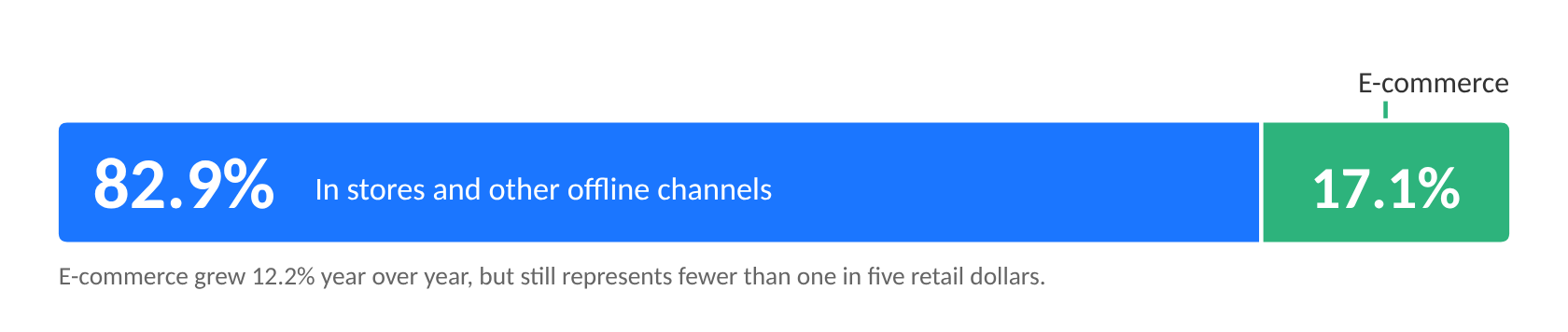
Source: U.S. Census Bureau, Quarterly Retail E-Commerce Sales, 2nd Quarter 2026
This creates three challenges for brick-and-mortar marketers:
At the same time, customers want relevance. Research from McKinsey shows that 71% of consumers expect companies to deliver personalized interactions.9 Brands must deliver that relevance with less third-party data and more scrutiny than ever before. Targeting has become both more important and more difficult.
Most businesses with physical locations already use social media, and many already advertise. The most common approaches, however, were built for online results and leave in-store conversions to chance.
The simplest form of social advertising is boosting a post to a wide audience defined by a few interests. It builds awareness quickly and inexpensively, but it treats a customer three miles away the same as one three states away. Without location-based targeting, a large share of the budget reaches people who will never be able to visit.
Multi-location brands often manage a single national account and post the same content for every market. Centralized posting keeps the brand consistent, but it misses the local relevance that drives visits: the opening of a new location, a neighborhood event, a store-specific promotion, or the faces of the staff behind the counter.
Impressions and likes show that content is resonating. They don’t show whether anyone walked through the door.
Many campaigns are still judged by impressions, Page Likes, and engagement rate. These metrics matter because they show that content is reaching and resonating with an audience, but they don’t show whether anyone visited. When reports stop at engagement, budgets naturally drift toward whatever earns the most likes rather than whatever earns the most customers.
Coupons that can only be redeemed in person are a proven way to draw customers in, and they provide a simple way to count conversions. On their own, though, they capture only the customers who remember to use them, and the data rarely makes its way back to the ad platform to improve future targeting.
Ad platforms have become increasingly automated. Meta now turns on its AI-driven Advantage+ audience by default, treats detailed interest targeting as a “suggestion” rather than a fixed limit, and has phased out detailed targeting exclusions.10 Automation can be powerful, but an algorithm can only optimize toward the goals and data it is given. If the only signals it receives are online clicks, it will find more people who click, not more people who visit.
“An algorithm can only optimize toward the goals and data it is given”
Bright Age
Each of these approaches has a place in a social media strategy. The problem is that none of them, used alone, connects the ad a customer sees to the purchase they make in store. Bridging that gap requires a more deliberate approach to who sees each campaign, what they see, and how results are measured.
The businesses seeing the strongest in-store results from social media combine precise targeting with local content and closed-loop measurement. The following practices form the foundation of an in-store conversion strategy.
Every in-store campaign should begin with geography. Location targeting lets a business limit ads to a radius around each store, the cities where its locations operate, or the ZIP codes its customers come from. For a single location, a tight radius keeps spending focused on people who can realistically visit. For a franchise or chain, separate ad sets or campaigns for each market allow budgets to follow performance location by location. Location remains a firm boundary even in AI-driven campaigns, which makes it the most reliable way to keep spending local.
Within each market, different customers respond to different reasons to visit. Students might respond to late-night hours and value pricing, while families respond to weekend events and kids’ menus. Splitting an audience into a few meaningful segments by age, life stage, or interest, and writing distinct creative for each, lowers costs and raises response. Bright Age’s campaigns for Dog Haus and Flip Flop Shops, detailed in the case studies below, both used this approach.
Location-specific pages and accounts give each store its own voice. They let a business share content that only matters locally, such as customer photos taken at that location, area-exclusive offers, staff spotlights, and community events. They also give local customers a place to ask questions and leave reviews. Responsiveness matters here: 73% of consumers say they will buy from a competitor if a brand doesn’t respond to them on social media.11
As third-party data becomes less reliable, a business’s own customer data becomes its most valuable targeting asset. Customer lists from loyalty programs, email subscribers, and point-of-sale systems can be uploaded as custom audiences to re-engage past visitors, excluded from acquisition campaigns to avoid paying to reach customers a business already has, or used as the seed for lookalike audiences that find new people who resemble its best customers.
“Advertisers using Meta’s Conversions API saw an average 17.8% lower cost per result”
Meta, 2026
The single most important step for brick-and-mortar advertisers is sending offline sales back to the ad platforms. Meta’s Conversions API, now the company’s recommended way to share offline and physical store events, lets a business report in-store purchases back to the platform, where they are matched to ad exposure.12 This accomplishes two things. It shows which campaigns actually produced store sales, and it teaches the platform’s AI to look for people who buy in store rather than people who simply click. Meta reports that advertisers using the Conversions API for web events see an average 17.8% lower cost per result,13 and in early testing, its omnichannel ads, which optimize toward both online and in-store sales, delivered a 15% lower cost per acquisition and a 12% higher return on ad spend.14
Automated tools such as Meta’s Advantage+ campaigns are designed to find buyers more efficiently than manual targeting, and Meta reports a 9% lower cost per action for Advantage+ sales campaigns.15 The best results come from giving that automation strong inputs, including firm location boundaries, customer-list exclusions, in-store conversion events, and a steady supply of fresh creative, and then measuring results against actual sales rather than platform-reported metrics alone.
Chart 2
Average reduction in cost per result, as reported by Meta
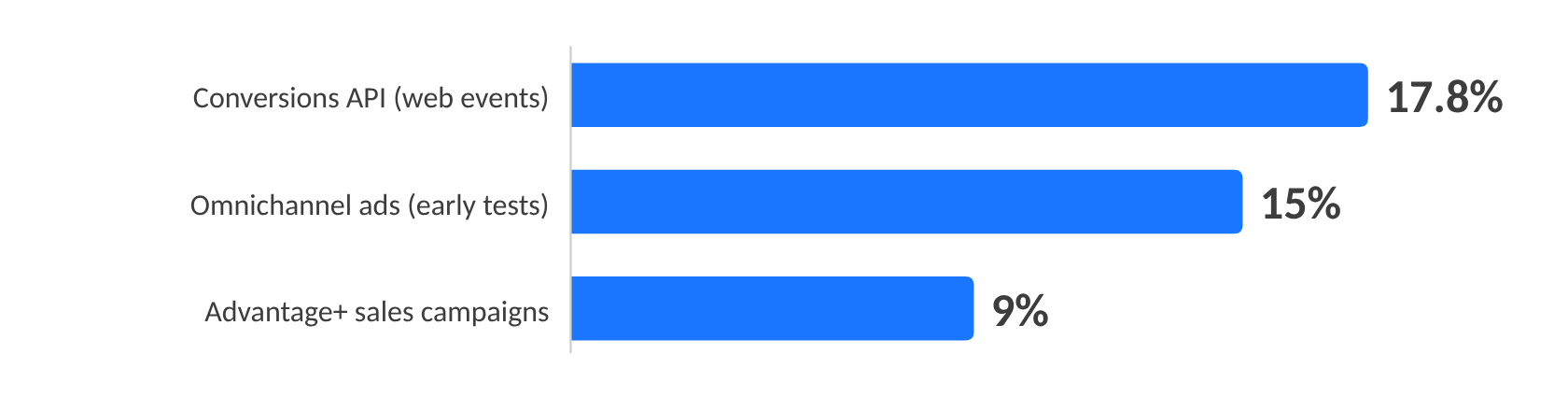
Sources: Meta (2026, 2025); Business Today (2025). Figures come from separate Meta tests and are not directly comparable.
Targeting finds the right customer, but the offer gets them out the door. Grand-opening specials, in-store-only discounts, text-to-redeem coupons, and limited-time events create urgency and give every campaign a measurable conversion point. When those offers are delivered to a well-defined local audience and the redemptions are fed back to the ad platform, every campaign makes the next one smarter.
Research from across the industry points to the same conclusion: social media shapes where customers shop, and brands that personalize and measure their targeting see the strongest returns.
Sprout Social’s 2025 research found that 76% of consumers say social content influenced a purchase in the past six months, including 84% of Millennials and 90% of Gen Z. Facebook remains the most widely used platform among consumers at 81%, followed by YouTube (71%) and Instagram (66%).5
Chart 3
Consumers who say social content influenced a purchase in the past six months
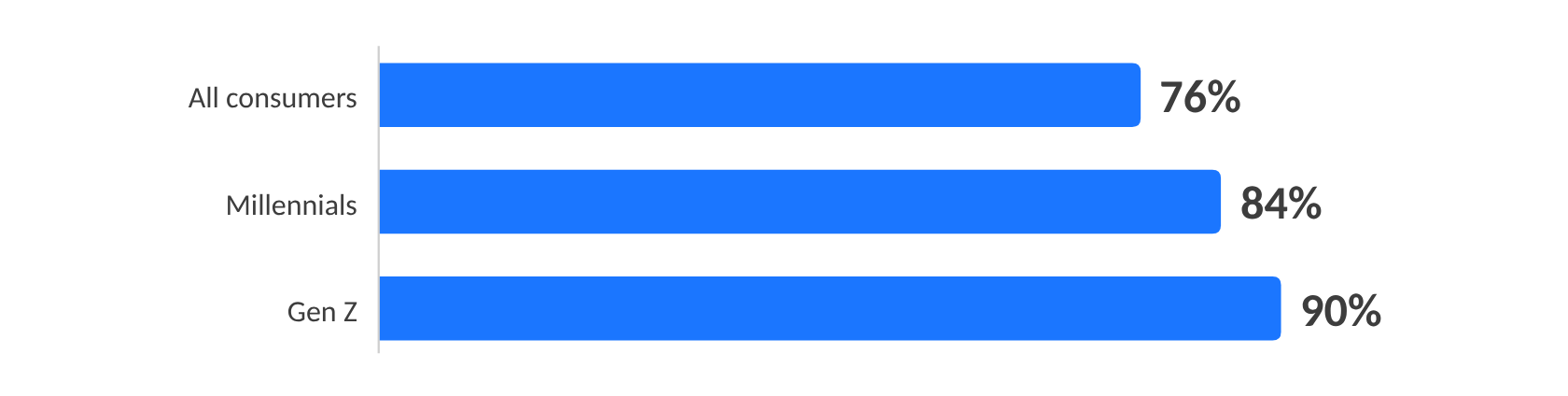
Source: Sprout Social, 2025
In Salsify’s 2025 consumer research of 1,910 U.S. and U.K. shoppers, 67% said they “webroom,” meaning they research a product online and then buy it in a physical store, while 54% named physical stores as one of the main places they discover new products and brands.4 The online and in-store journeys are not separate; they are two halves of the same purchase.
Personalization most often drives a 10–15% revenue lift
McKinsey’s research found that personalization most often drives a 10% to 15% revenue lift, and that companies that excel at personalization generate 40% more revenue from those activities than average players.9 For businesses with physical locations, location is often the most powerful form of personalization available: an offer for the store down the street is inherently more relevant than an offer for a store across the country.
Social media is projected to account for 29.4% of all global ad spending in 2026. Together with search and retail media, it will capture two-thirds of global advertising budgets, as marketers favor channels that can be targeted precisely and measured against results.1 In the United States, social commerce sales are projected to surpass $100 billion in 2026 for the first time.16
Across more than 1,000 U.S. Facebook campaigns analyzed by WordStream and LocaliQ, traffic campaigns averaged a 1.71% click-through rate at an average cost of $0.70 per click, while lead campaigns averaged a 2.59% click-through rate.17 Well-targeted local campaigns can far exceed these averages. Bright Age’s segmented grand-opening campaign for Dog Haus, for example, achieved a click-through rate above 7%, roughly four times the traffic-campaign benchmark.18
Taken together, the research shows that consumers are ready to be reached on social media, and that many of them still prefer to buy in person. The opportunity belongs to the brands that can connect the two.
Bright Age has put these practices to work for brick-and-mortar clients across entertainment, restaurants, and retail. The following three campaigns show how location-based targeting, audience segmentation, and local community building translate into real-world results.
Entertainment · 15 locations
Galaxy Theatres is a luxury movie theatre chain with 15 locations across the western United States. As the company grew, it wanted to keep the local, personal feel of a neighborhood theatre while growing its online communities and, above all, its online ticket sales.
Rather than relying on a single corporate account, Bright Age created a dedicated Instagram account for each of the 15 locations, giving every theatre its own community. Content was localized to each market and featured photos from fans at that location, area-exclusive offers and discounts, and spotlights on local staff. Geotargeting was at the core of the strategy: posts were boosted to audiences targeted by both location and interests, and ongoing campaigns drove Facebook Page Likes and clicks to the ticketing website. Bright Age’s community management team monitored each location’s Facebook, Instagram, and Yelp pages several times a day, responding to questions and reviews, both positive and negative.
The campaign drove a 72% increase in online ticket sales from social media, while the location-specific Instagram accounts grew followers by 202% and Instagram likes by 395%.19
Chart 4
Increase after launching location-specific, geotargeted social media
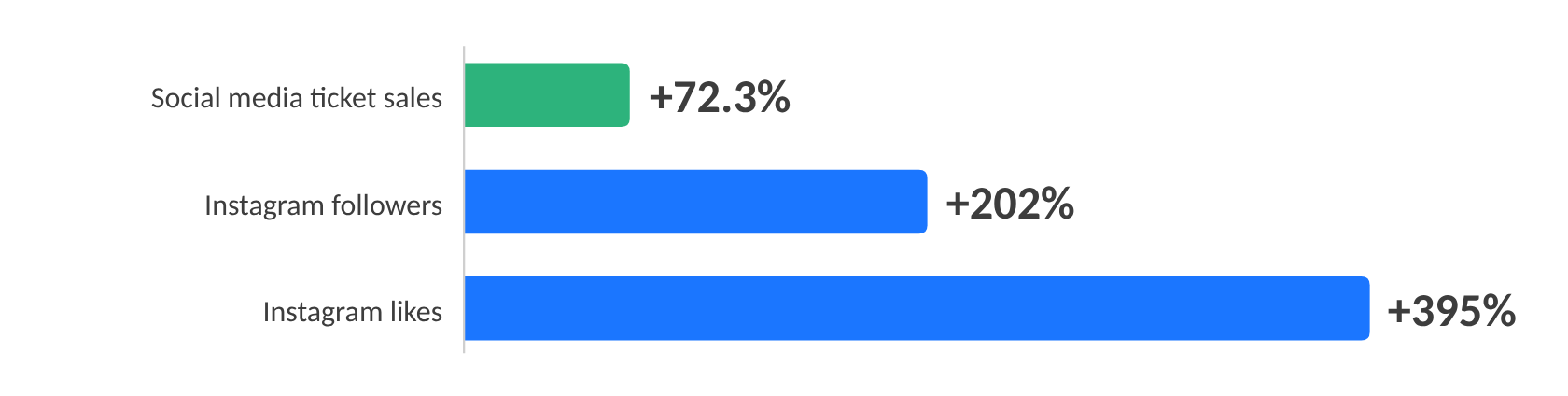
Source: Bright Age, Galaxy Theatres case study. Ticket sales highlighted as the in-store conversion metric.
Restaurants · Franchise grand opening
When Dog Haus, the craft-casual hot dog restaurant, prepared to open its first franchised location in Canoga Park, California, the brand faced a familiar challenge for any expanding restaurant: building awareness and word of mouth in a market that didn’t know it yet.
Bright Age built the campaign on Facebook and used the platform’s targeting to create a local online community before the doors opened. The local audience was split into two segments, adults and students, and each received its own messaging and Page Like ads tailored to what would bring that group in. Leading up to opening day, Bright Age published content designed to build cravings and anticipation, and responded to every customer question promptly and in line with corporate guidelines.
The campaign turned online anticipation into a line out the door, with more than 1,200 meals served on opening day.20 Bright Age has since applied the same approach to more than 20 additional Dog Haus franchise locations.
Retail · International franchise
Flip Flop Shops is a footwear retailer with franchised locations across the United States, Canada, the Caribbean, South Africa, and the Middle East. The brand wanted to build a large community on its corporate Facebook page while giving each franchise its own page that felt personal and authentic to its local customers.
Bright Age ran a Page Likes campaign for the corporate page that was targeted specifically to the cities where shops are located, so that growth came from people who could actually visit a store. The audience was divided into four ad sets by gender and age group, each with its own creative. At the same time, every location page received daily content, with shop owners adding their own local posts alongside Bright Age’s.
Within two months, the city-targeted campaign had grown the brand’s Facebook audience in the markets where its stores operate and increased the reach of its content by 51% month over month.21
Across three very different businesses, the common thread is the same. Each campaign started with where customers are, spoke to who they are, and gave them a local reason to visit.
Social media has become the place where customers discover where to eat, what to watch, and where to shop. For businesses with physical locations, the opportunity is enormous, but only for those that target with purpose. Reaching millions of people means little if they can’t, or won’t, visit. Reaching the right few thousand people within driving distance, with a message made for them and an offer that gives them a reason to come in now, is what turns social media into revenue.
The tools to do this are more powerful than ever. Location targeting keeps campaigns local, audience segmentation keeps them relevant, location-level communities make them personal, and in-store conversion data teaches ad platforms to find real customers. The businesses that put these pieces together, and that measure success by sales rather than likes, will win the customers their competitors are only reaching.
That is where an experienced partner makes the difference. Building geotargeted campaigns for dozens of locations, managing local communities around the clock, and connecting point-of-sale data to ad platforms all require time, expertise, and constant optimization. Bright Age has done this work for movie theatres, restaurants, and retailers, and is ready to help your business turn its online audience into in-store customers.
By reaching people who can realistically visit, giving them a local reason to come in, and measuring results by store sales. Location targeting, audience segmentation, location-level communities, and in-store-only offers work together to turn an online audience into foot traffic.
Geotargeting limits who sees an ad based on location, such as a radius around a store, specific cities, or ZIP codes. A single location can use a tight radius to keep spending focused on people nearby, while a franchise or chain can run separate ad sets for each market so budgets follow performance.
Send offline sales back to the ad platform. Meta’s Conversions API lets a business report in-store purchases, which are matched to ad exposure. That shows which campaigns produced store sales and helps the platform find more real buyers. Promo codes and text-to-redeem coupons add a simple, countable conversion point.
Both. A corporate page keeps the brand consistent, while location-specific pages share what only matters locally, such as customer photos, area-exclusive offers, staff spotlights, and community events. Bright Age’s location-by-location Instagram accounts for Galaxy Theatres grew followers by 202%.
Bright Age is a full-service digital creative and social media agency headquartered in Los Angeles, with its office in Westlake Village, California. Bright Age has grown from a local social media partner for restaurants and retailers into a national agency serving brands in entertainment, hospitality, health care, consumer packaged goods, and restaurants and retail, from local businesses to Fortune 500 companies.
Bright Age’s core services are content creation, social media community management, and social media and Google ad management. These are supported by social media strategy, copywriting, 24/7 social media customer care, online reputation management, search engine optimization, market research, influencer management, and analytics and reporting. Every client receives a custom-built service package and a dedicated in-house team.
Bright Age has received multiple industry awards for its social media management and creative ad strategy work, including the dotCOMM Awards, Hermes Creative Awards, MarCom Awards, and AVA Digital Awards, and is a certified Google Partner and Meta Business Partner.
Chart sources
Talk with our team of social media experts who understand your brand and the strategies that work in your industry.


