White Paper
How Brands Should Market to Each Generation
By the Bright Age Digital Creative Agency team · Updated October 2026

White Paper
By the Bright Age Digital Creative Agency team · Updated October 2026

Every generation is on social media now, but no two generations use it the same way. Gen Z searches for answers on social platforms, Millennials shop through their feeds, Gen X turns to Facebook and YouTube, and Baby Boomers, who hold more than half of all U.S. household wealth, are far more active online than many marketers assume. Brands that run one message on one platform for everyone are leaving customers behind.
Learn how to:
Four generations now share the same feeds. A 22-year-old college student, a 38-year-old parent, a 54-year-old business owner, and a 70-year-old retiree may all scroll through Facebook, YouTube, or Instagram on the same afternoon. Social media is used by 5.79 billion people worldwide,1 and advertisers will spend $394.6 billion to reach them in 2026.2
Sharing a platform is not the same as sharing a mindset, however. Each generation came of age with different technology, different economic realities, and different expectations of brands. Gen Z has never known a world without smartphones. Millennials grew up alongside social media itself. Gen X watched the internet arrive as teenagers and young adults, and Baby Boomers adopted it later in life, but in steadily growing numbers. To market effectively, brands need to understand not only where each generation spends its time online, but how each one wants to be spoken to once they get there.
Generational definitions: Pew Research Center3
Most brands know that their customers span multiple generations. Far fewer have a marketing plan that reflects it. Four common blind spots stand in the way.
“Baby Boomers hold 51.6% of all U.S. household wealth”
Federal Reserve, 2026
Social media marketing is often treated as a young person’s game, with budgets and creative aimed squarely at Gen Z and younger Millennials. The money tells a different story. According to the Federal Reserve, Baby Boomers hold 51.6% of all U.S. household wealth and Gen X holds another 26.1%, while Millennials and Gen Z combined hold 11%.4 Households headed by someone ages 45 to 54, the heart of Gen X, spent an average of $100,327 a year, about 28% more than the average U.S. household.5 Brands that ignore older generations on social media are overlooking the customers with the most to spend.
Older generations are far more active online than many marketers assume. According to Pew Research Center, 85% of Americans ages 50 to 64 and 65% of those 65 and older use YouTube, and 71% and 59%, respectively, use Facebook.6 The question is not whether older consumers are on social media, but whether brands are reaching them there with content that fits.
Even brands that reach every generation often show all of them the same ad, but what persuades a 24-year-old rarely persuades a 64-year-old. In a 2025 study by Emplifi, 46% of Gen Z said interactivity makes a brand’s video stand out, compared with just 15% of Baby Boomers, while 84% of Boomers said informativeness is their priority.7 A single creative approach will inevitably underperform with someone.
Each generation’s social life is spread across a different mix of platforms. TikTok reaches 65% of U.S. adults under 30 but just 11% of those 65 and older, and Snapchat reaches 56% of adults under 30 but only 4% of seniors.6 A strategy built around a single platform will miss entire generations, while a strategy that tries to be everywhere at once spreads budgets too thin to matter.
Most brands already make some effort to account for age in their marketing. The most common approaches, however, tend to be blunt instruments.
Ad platforms make it easy to set an age range, and many brands do little more than that. Age targeting is a useful starting point, but it only determines who sees an ad, not whether the ad speaks to them. Platforms also increasingly treat detailed targeting as a suggestion and expand audiences automatically,8 which means the creative itself now does much of the work of finding and persuading the right people.
When a new platform takes off, brands often rush to it with little thought about who is actually there. A strong TikTok presence can be valuable, but if a brand’s best customers are Gen X homeowners, the same effort may do far more on Facebook or YouTube.
Every generation includes a wide range of incomes, interests, and life stages
Generational marketing is full of clichés, from Millennials who spend everything on avocado toast to Boomers who can’t work a smartphone. Stereotypes make for catchy headlines, but they produce condescending ads. Every generation includes a wide range of incomes, interests, and life stages, and consumers notice when a brand reduces them to a punchline.
Many brands still reach older customers mainly through television, print, and direct mail, and reserve social media for younger buyers. Traditional channels still have a role, but this approach misses the millions of Gen X and Baby Boomer consumers who now discover, research, and buy through social platforms. Nearly three in ten Baby Boomers made a purchase on social media in just the past three months.7
The most effective generational marketing starts with the same principle as all good marketing: know your audience. The playbook below outlines where each generation spends its time on social media and what tends to move it to act. These are starting points, not rules, and every brand should test and refine them with its own data.
Born 1997–2012
Where to reach them
YouTube (95% of U.S. adults under 30), Instagram (79%), Facebook (69%), TikTok (65%), and Snapchat (56%).6
What they respond to
Born 1981–1996
Where to reach them
YouTube (91% of U.S. adults ages 30 to 49), Facebook (78%), Instagram (64%), and TikTok (45%).6
What they respond to
Born 1965–1980
Where to reach them
Gen X spans Pew’s 30-to-49 and 50-to-64 age groups. Among adults 50 to 64, 85% use YouTube, 71% use Facebook, 41% use Instagram, and 32% use LinkedIn.6
What they respond to
Born 1946–1964
Where to reach them
Among U.S. adults 65 and older, 65% use YouTube, 59% use Facebook, 21% use Instagram, and 20% use WhatsApp. Younger Boomers, ages 62 to 64, fall within Pew’s 50-to-64 group, where usage is higher still.6
What they respond to
Recent research paints a clear picture of how the generations differ on social media, and where they overlap.
Pew Research Center’s 2026 survey of U.S. adults shows that YouTube is the only platform used by a majority of every age group. Facebook is the most consistent across generations, used by between 59% and 78% of each age group. Instagram, TikTok, and Snapchat skew sharply younger, while usage of nearly every platform declines with age.6
Chart 1
Share of U.S. adults in each age group who use each platform, 2026
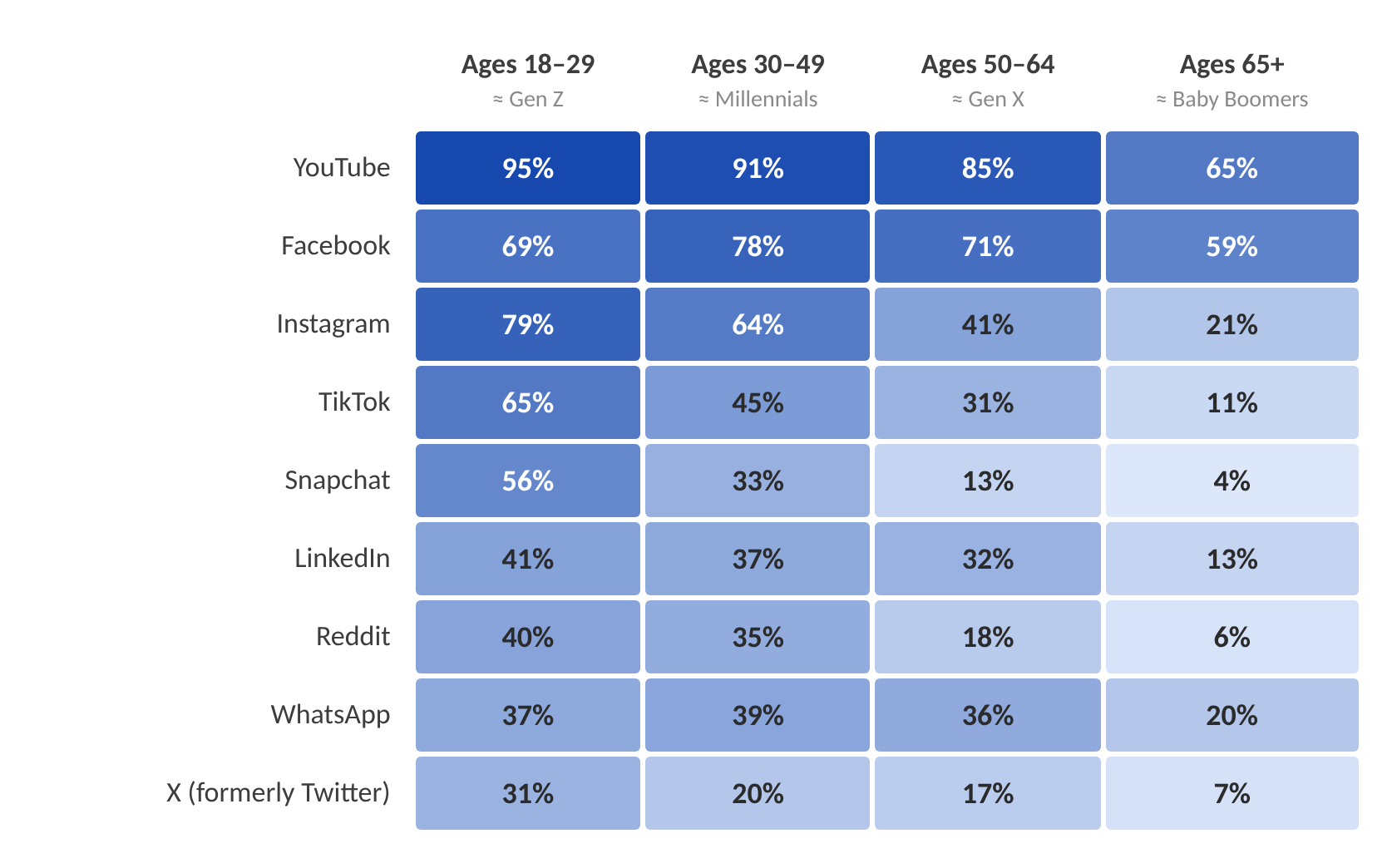
Source: Pew Research Center, Social Media Fact Sheet, 2026. Pew’s age groups approximate the generations: 18–29 (Gen Z), 30–49 (Millennials), 50–64 (Gen X), and 65+ (Baby Boomers).
More than half of Millennials (56%) and Gen Z (53%) made a purchase on social media in the past three months, compared with 39% of Gen X and 29% of Baby Boomers.7 Younger generations lead, but social commerce is no longer limited to the young: nearly three in ten Boomers already buy through social platforms.
Chart 2
Share who made a purchase on social media in the past three months
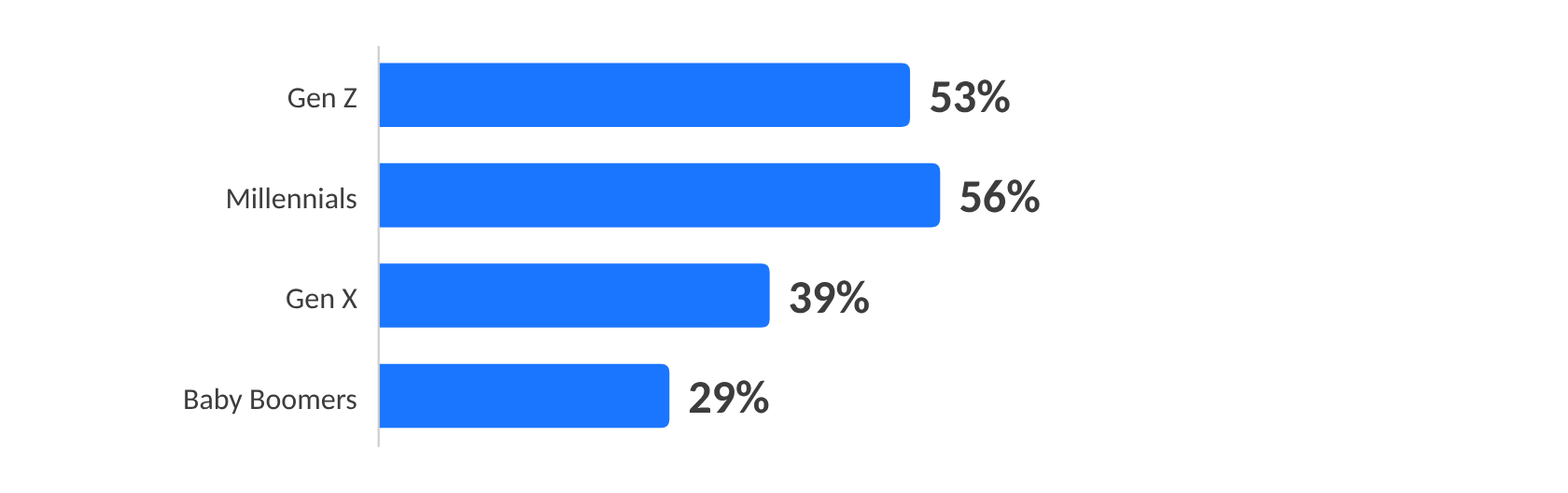
Source: Emplifi survey of nearly 1,000 U.S. consumers, 2025
In Sprout Social’s 2025 research, 76% of consumers said content on social media had influenced a purchase in the past six months. Among Millennials that figure rises to 84%, and among Gen Z it reaches 90%. Gen Z and Millennials are also leading the move to community and creator platforms: 63% plan to spend more time on community platforms such as Reddit.9
The generations most likely to buy on social media are not the ones with the most money to spend. Baby Boomers and Gen X together hold more than three-quarters of all U.S. household wealth.4 A complete social strategy reaches younger buyers where they shop today and older buyers where their spending power is concentrated.
Chart 3
Q1 2026
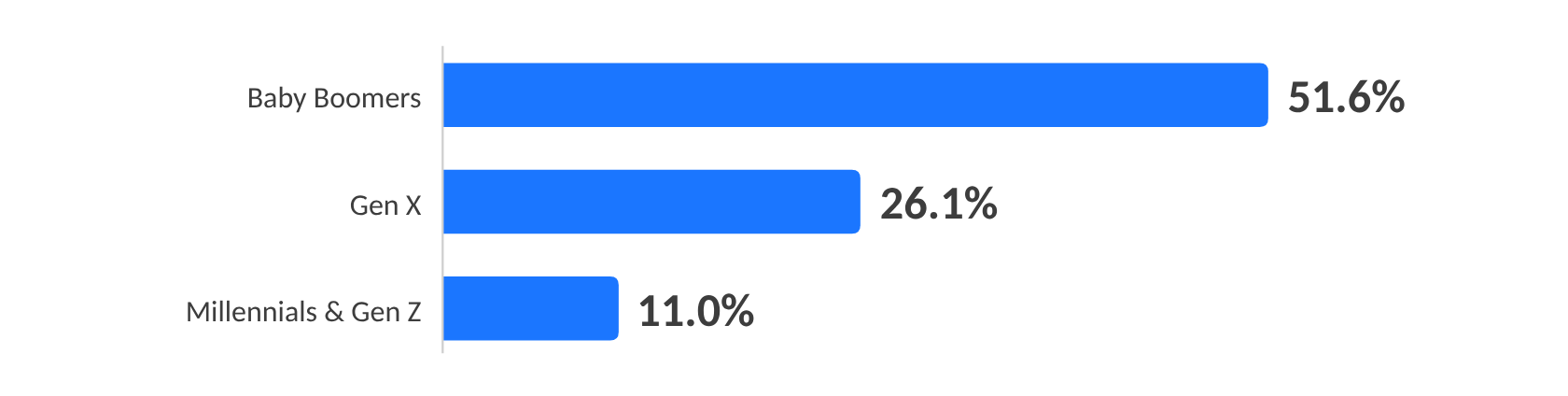
Source: Federal Reserve, Distributional Financial Accounts. The Fed reports Gen Z within its Millennial group; the remaining 11.3% is held by earlier generations.
When customers reach out, older generations want a person. Eighty percent of Gen X and 81% of Baby Boomers expect to deal with a human rather than a bot, while 30% of Gen Z and Millennials say they are more likely to contact a brand through a direct message on social media.7 Speed matters to everyone: in a separate Emplifi survey, 32% of U.S. social media users said they expect a brand to respond within an hour.13
Bright Age builds campaigns around the distinct audiences inside each client’s customer base. The following examples show how matching the platform, message, and creative to each group outperforms a single campaign for everyone.
Health care · Multi-generational audience
Chart 4
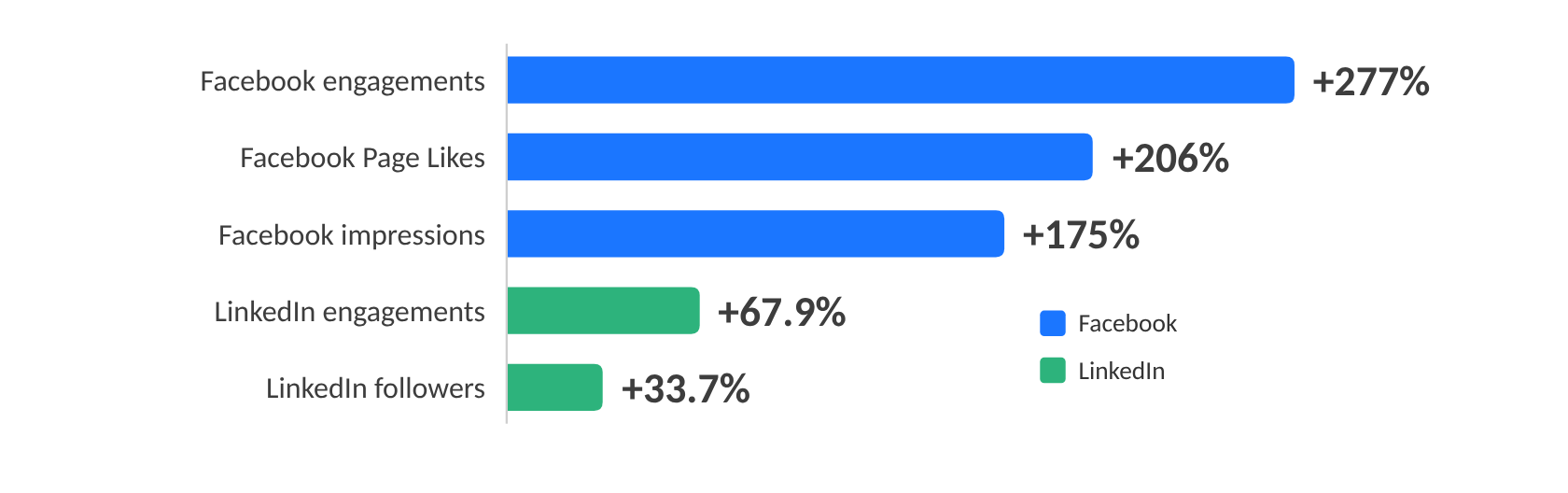
Source: Bright Age, SuperCare Health case study
SuperCare Health is a respiratory care provider that manages high-risk patients at home, offering oxygen and ventilation products and in-home personal care across California, Nevada, New Mexico, and Texas. Its customers span generations: older adults who need respiratory care, the adult children and caregivers who support them, parents of young children who need respiratory services, and the medical professionals who refer patients.
Rather than running one campaign for everyone, Bright Age defined four distinct audiences and matched each to the right platform and message. Hyper-targeted Facebook Page Like campaigns, boosted posts, and click-to-website ads reached patients, caregivers, and parents, while sponsored LinkedIn content reached medical professionals. Each audience received customized images and copy, and creative was A/B tested within each group and optimized toward the lowest-cost results. Organic content featured the product line and the people who use it, behind-the-scenes posts of staff with patients, and awareness moments such as COPD Awareness Month and Respiratory Care Week.
Over the course of one year, the program increased Facebook engagements by 277% and Facebook Page Likes by 206%, while LinkedIn engagements grew 67.9% and LinkedIn followers grew 33.7%.14
Restaurants · Students and adults
For the grand opening of its first franchised location in Canoga Park, California, Dog Haus needed to win over two very different local audiences: students and adults. Bright Age split the Facebook audience into those two segments and created distinct messaging and Page Like ads for each, which lowered the cost per Page Like and raised the campaign’s click-through rate.15 The campaign grew the location’s Facebook Page Likes by 1,636% before opening day, and Dog Haus served more than 1,200 meals when its doors opened.16
Retail · Age- and gender-based creative
To grow its corporate Facebook community, Flip Flop Shops worked with Bright Age on a Page Likes campaign targeted to the cities where its shops are located and divided into four ad sets by gender and age group, each with its own creative. In the first month, the page’s followers grew 13%. In the second month, Facebook impressions climbed 51% to more than one million, and post engagements and reactions rose 18%.17
Each of these campaigns succeeded for the same reason. Instead of asking one message to work for everyone, Bright Age identified the distinct groups within each client’s audience and built a campaign for each of them.
Generational marketing is not about stereotypes, and it is not about choosing one generation over another. It is about recognizing that Gen Z, Millennials, Gen X, and Baby Boomers all spend time on social media, and that each responds to a different mix of platforms, content, and tone.
The brands that win will meet each generation where it is: Gen Z with searchable, creator-led short-form video; Millennials with reviews, value, and shoppable content; Gen X with clear, practical information and responsive service; and Baby Boomers with trustworthy, informative content on the platforms they already use every day. Above all, they will test, measure, and refine, letting real results rather than assumptions guide how they speak to each audience.
Running four audience strategies at once takes time, expertise, and constant optimization. Bright Age builds custom social media programs that segment audiences, create tailored content for each one, manage communities around the clock, and measure what works. Whether your best customers are scrolling TikTok or Facebook, Bright Age can help you reach them with a message that fits.
According to Pew Research Center, YouTube is the only platform used by a majority of every U.S. age group, and Facebook is the most consistent across generations, used by between 59% and 78% of each age group. Instagram, TikTok, and Snapchat skew sharply younger.
Yes. 65% of Americans 65 and older use YouTube and 59% use Facebook, and usage is higher still among adults 50 to 64. Nearly three in ten Baby Boomers have made a purchase on social media in the past three months.
With short-form, vertical video that feels native to the platform, creator partnerships and user-generated content, personality and humor, and searchable content. 41% of Gen Z turn to social platforms first when looking for information.
Using Pew Research Center’s definitions, Gen Z was born 1997–2012, Millennials 1981–1996, Gen X 1965–1980, and Baby Boomers 1946–1964.
Bright Age is a full-service digital creative and social media agency headquartered in Los Angeles, with its office in Westlake Village, California. Bright Age has grown from a local social media partner for restaurants and retailers into a national agency serving brands in entertainment, hospitality, health care, consumer packaged goods, and restaurants and retail, from local businesses to Fortune 500 companies.
Bright Age’s core services are content creation, social media community management, and social media and Google ad management. These are supported by social media strategy, copywriting, 24/7 social media customer care, online reputation management, search engine optimization, market research, influencer management, and analytics and reporting. Every client receives a custom-built service package and a dedicated in-house team.
Bright Age has received multiple industry awards for its social media management and creative ad strategy work, including the dotCOMM Awards, Hermes Creative Awards, MarCom Awards, and AVA Digital Awards, and is a certified Google Partner and Meta Business Partner.
Chart sources
Talk with our team of social media experts who understand your brand and the strategies that work in your industry.


