White Paper
How to Use Social Media to Drive In-Store Sales
By the Bright Age Digital Creative Agency team · Updated October 2026

White Paper
By the Bright Age Digital Creative Agency team · Updated October 2026

As our society continuously shifts online, it’s important to remember the benefits of real-life, person-to-person experiences. The focus on driving in-store sales continues to grow, even as it becomes more difficult with each new day. Many businesses are now turning to social media in hopes of capturing their audiences’ attention in a new way.
Learn how to:
Technology is becoming increasingly accessible and advanced with each new day. It’s no surprise that nearly three-quarters of the world’s population, 6.12 billion people, is now on the internet.1 The massive number of people logging on has led to substantial growth across multiple social media platforms over the past several years. People aren’t the only ones taking advantage of these platforms, though. More businesses are logging on than ever before in hopes of attracting customers in entirely new ways. The internet is no longer solely a place for people to chat and discover information, but a newfound hotspot for stores to differentiate themselves. Big and small businesses alike now face the task of harnessing the attention their brand attracts on social media and converting it into in-store sales. How can a business successfully get potential customers off their computers and phones and into the store?
The internet has opened doors in the world of shopping that, at one point in time, could never have been imagined. Having the ability to buy and sell products from opposite sides of the world is a total game changer. According to Deloitte, digital interactions influence 56 cents of every dollar spent in brick-and-mortar stores, or approximately $2.1 trillion in total.2 Denying the influence of the internet is no longer an option, and while the benefits of this technology to both consumers and producers are undeniable, there have been definite consequences for old-fashioned brick-and-mortar storefronts.
Chart 1
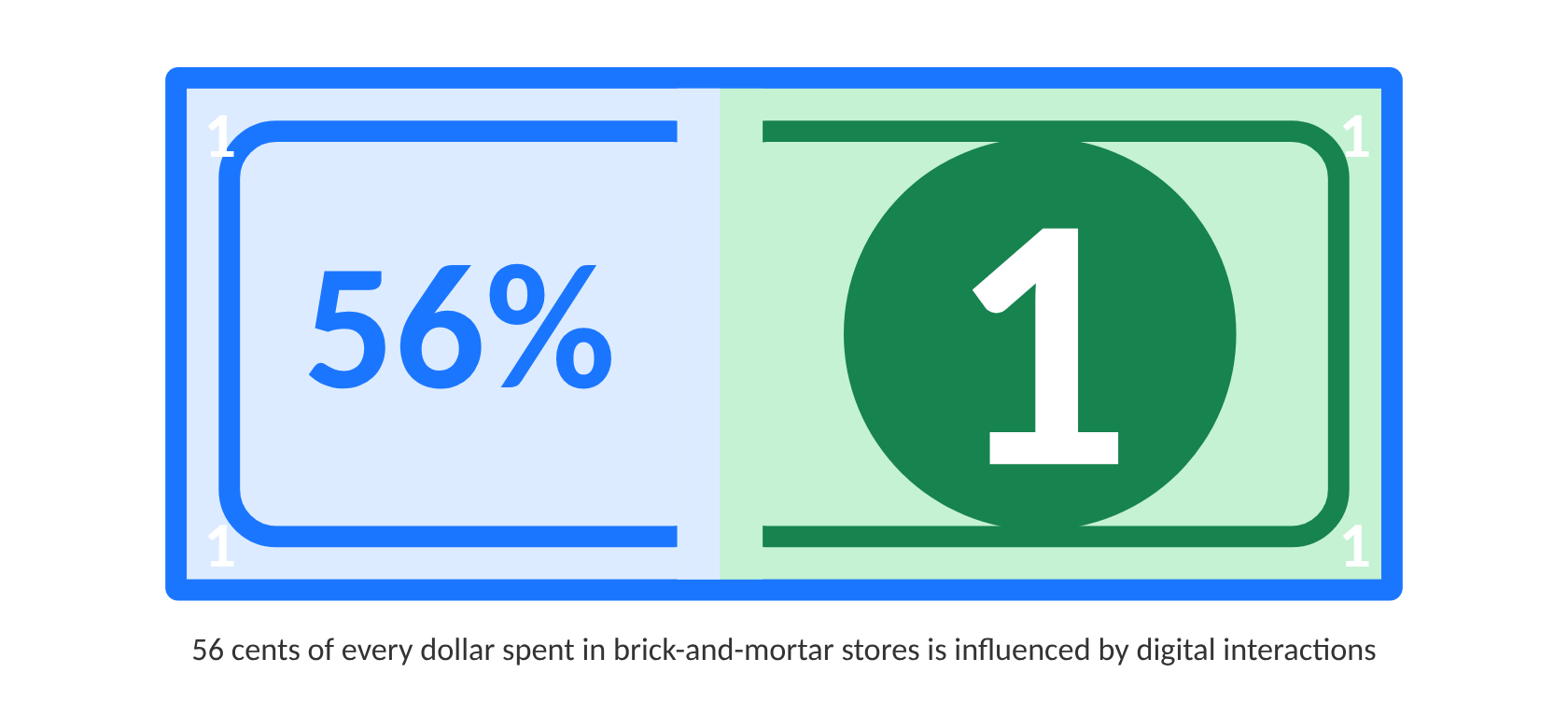
Source: Deloitte, via Retail Dive
In just three years, U.S. stores received approximately half as much holiday foot traffic as before
There once was a time when if you needed something, you got off your couch, drove to the store, purchased the product, and returned to the couch. Today, a purchase can be made directly from the couch. This modern method spares consumers time and energy by eliminating the hassle in between that we refer to as “moving.” While food and entertainment, for the most part, must still be driven to, retail can now come to you via the internet. This convenience for shoppers has created a new problem for many stores. In the span of just three years, U.S. stores received approximately half as much foot traffic during the holiday season as they had before.3 Yet even as foot traffic has declined, sales have grown steadily: U.S. retail sales rose 6.7% year over year in the second quarter of 2026.4 Although overall consumer spending is increasing, attracting customers into your store is proving to be both more crucial and more difficult.
Businesses understand the enormous role that social media plays in consumerism and are joining in quickly. In retail, a striking 91% of retail brands use two or more social media platforms.5 At this point, though, merely having a social media account will no longer give you a much-needed competitive advantage. Your brand needs to have accounts and use them effectively. Racking up followers and interacting with users is an important part of making your brand stand out. These social media platforms can be incredibly helpful in getting the word out about a brand, but that doesn’t necessarily translate into in-store sales. In many cases, improved and growing technology has not carried over into an improved and growing brick-and-mortar shopping experience.
Consumers are willing to pay an average of 50% more for items that they can touch and see in-store
Why does driving in-store sales even matter? With consumer spending at record highs,6 is there really a need to attract customers into your physical stores? The issue is that online shopping and buying is entirely different from the in-store experience. Once you bring a potential customer into your store, it becomes easier to convert them into a paying customer. On top of this, Caltech found that consumers are willing to pay an average of 50% more for items they can touch and see in-store.7 Your brand’s success and profit can be increased by understanding the significance of the in-store shopping experience. From the design and feel of the location to the customer service provided by employees, the tone for your brand is set largely in-store. Nothing compares to the personal feel of in-store shopping. Being able to speak with and help customers in person can lead to a better experience for them and increased sales for the store.
Even after years in which in-store traffic fell at an alarming rate of as much as 15% annually,8 nearly 83% of U.S. retail sales still happen outside of e-commerce.4 As online shopping grows, the power of brick-and-mortar stores should not be overlooked in your brand’s success.
To combat the recent decline in in-store sales, many businesses have begun taking advantage of the creative and effective marketing tactics available through social media. Giving your followers a reason to come in is the key to handling this growing problem. This use of social media goes beyond brand awareness and online engagement to attracting customers to the physical store location. If millions of users view your post but no one acts on it, it’s a failed post.
Businesses are currently trying a variety of strategies on multiple platforms to drive in-store sales. The most obvious and prevalent involves posting online coupons and codes that can only be redeemed in-store. Just as effective as discounts are freebies. By posting about in-store giveaways, you can easily draw in customers. Another existing solution for driving in-store sales is the use of loyalty programs. From Panera to Chipotle, successful businesses have been rewarding consumers for their loyalty for years.
Delivering reasons to physically travel to a store via social media posts is not the only way these platforms can grow in-store sales. Social media can drive these sales indirectly as well. Customer service and online interaction with users prove to be very beneficial. If you can give your customers a good experience on social media when they need it, they are more likely to return. In fact, 78% of small businesses attract new customers and engage current ones using social media.9 On top of this, social media gives businesses a direct look into what consumers are saying about their brands. If interpreted accurately, knowing how your brand is perceived by the general population can be translated directly into better in-store sales.
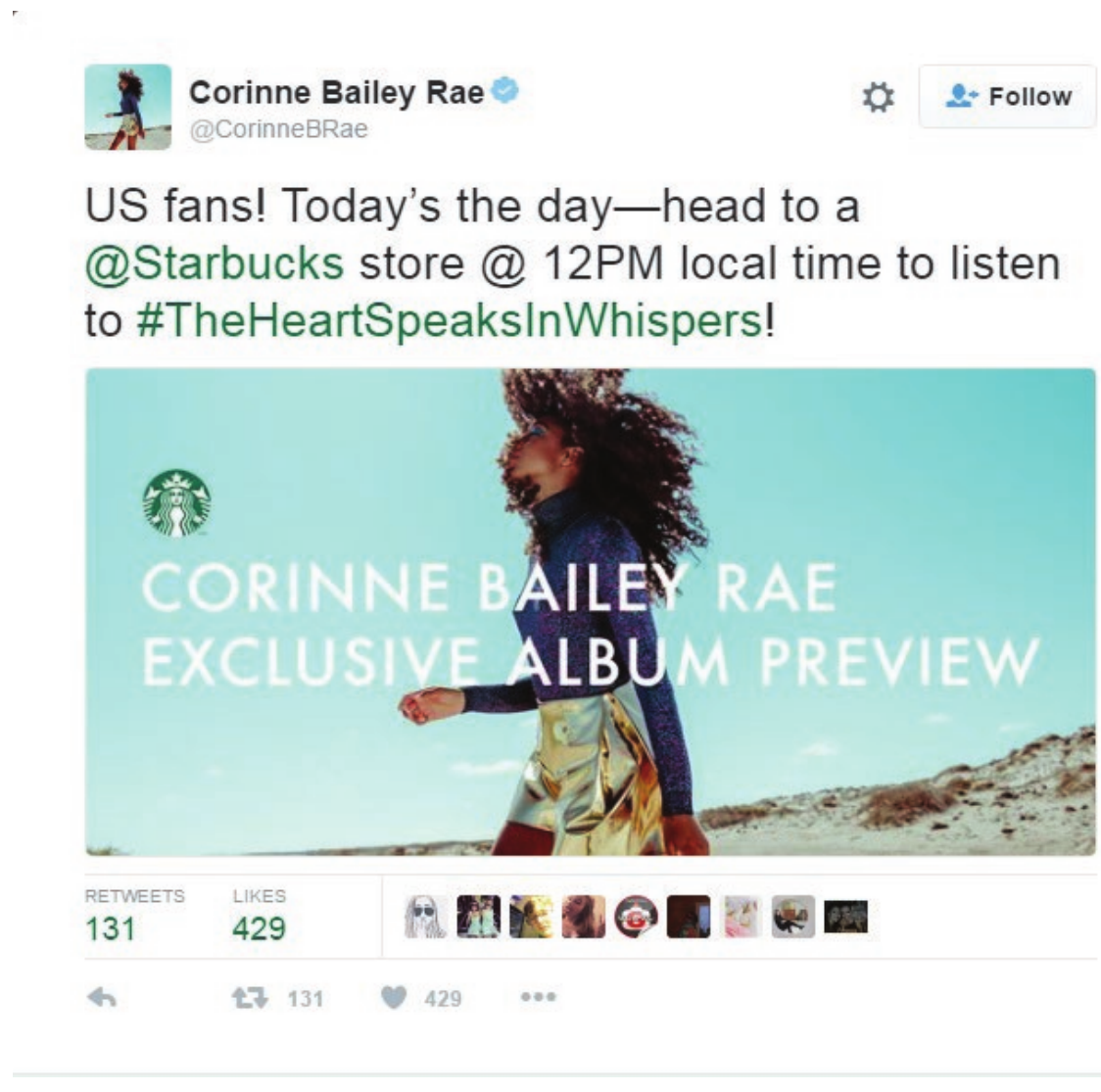
Starbucks is one company that has repeatedly done an excellent job of converting social media posts into in-store sales. Its Twitter account is full of clever and creative tweets focused on getting customers to drop in. In one case, Starbucks partnered with artist Corinne Bailey Rae to give an exclusive preview of her album, The Heart Speaks in Whispers, in its stores only. By partnering with Corinne, Starbucks made sure her true fans would stop by a store and grab a drink while listening to the preview. On top of this, both Starbucks and Corinne tweeted the announcement to their followers. The partnership drove both profit for Starbucks and exposure for Corinne, the best of both worlds. Starbucks’ creative and engaging Twitter account clearly paid off: at the time, it had the third-largest following of any brand on Twitter, behind only Chanel and Samsung.10
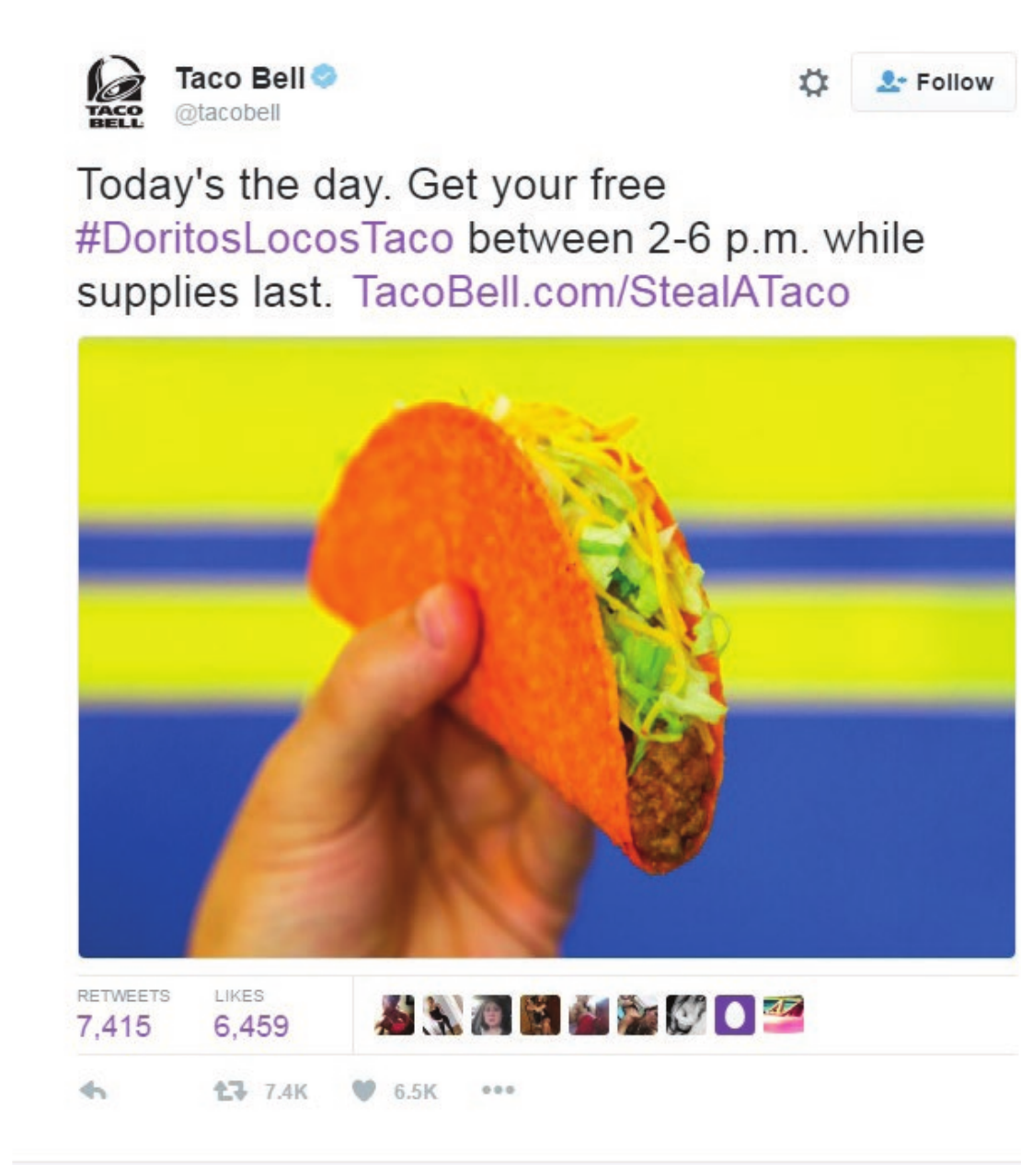
Taco Bell is another example of a brand that has excelled in the world of social media. Taco Bell once used Twitter to advertise free Doritos Locos Tacos between 2 and 6 p.m. The tweets from Taco Bell’s account leading up to the event resulted in thousands of views and retweets, and ultimately more publicity for the occasion. Although its Twitter account is famous for its comical tweets and good customer service,11 Taco Bell’s most famous advertising campaign has to be its Snapchat lens. On Cinco de Mayo, Taco Bell released a Snapchat lens that turned the user’s face into a giant taco. While the idea sounds ridiculous, it resulted in a shocking 224 million views in one day.12 At the time, it was reported to be the most-viewed campaign in Snapchat’s history.
From Starbucks to Taco Bell, the food industry seems heavily invested in discovering new tactics that will draw customers into stores, yet the retail industry continues to struggle. With Black Friday store sales once dropping by nearly $1 billion in a single year,13 clothing stores need the food industry’s success at attracting customers through social media.
“Each month, customers engage with our Pins hundreds of thousands of times, generating millions of impressions and significant site traffic and demand.”
One major retail chain that has embraced social media to bring in customers is Nordstrom. The chain focused on bridging the gap between online shopping and the in-store experience by taking advantage of the social media giant Pinterest. Stores began labeling their “Top Pinned Items,”14 a program that drew attention to in-store items that were popular online. The initial feedback was so positive that the program was rolled out to all 117 store locations. Nordstrom’s social media manager, Bryan Galipeau, was quoted as saying, “Each month, customers engage with our Pins hundreds of thousands of times, generating millions of impressions and significant site traffic and demand.”15 This is a clear example of the effectiveness of using social media for the in-store experience.
This approach to embracing social media focuses on making the overall shopping experience more fluid, both online and in-store. As the idea continues to develop and expand, in-store sales are sure to increase with the new shopping convenience.
Today, the need to stand out from your competitors is bigger than ever. Differentiating yourself in a saturated market can be difficult, though. While there have been many social media campaigns focused on attracting new in-store customers, they are only beginning to unleash the full potential of social media.
According to Forrester Research, the most important reason consumers shop in-store is not wanting to wait for a product to arrive.7 When consumers shop in-store, they can purchase a product and use it immediately. Brands hoping to increase their brick-and-mortar sales should capitalize on this instant experience, since it is the biggest selling point for consumers. Following right behind instant purchasing power is the ability to touch, feel, or try on a product before buying it.7 Consumers love the guarantee of knowing what they are spending their money on. By emphasizing the in-store perks of instant gratification and firsthand experience of the product in your marketing campaign, you will remind customers why they love in-store shopping and, in turn, draw them to your location.
The social media account of any brand trying to drive in-store sales should focus on what consumers enjoy about the in-store experience. Gap emphasized the importance of in-store shopping in one of its campaigns, which allowed consumers to reserve clothing online at select Gap stores for up to 24 hours. The reservation system lets customers try on potential purchases before they actually commit, solving a previous problem with in-store pickup. This online approach to increasing in-store sales is a great way to merge the online and offline worlds of shopping.
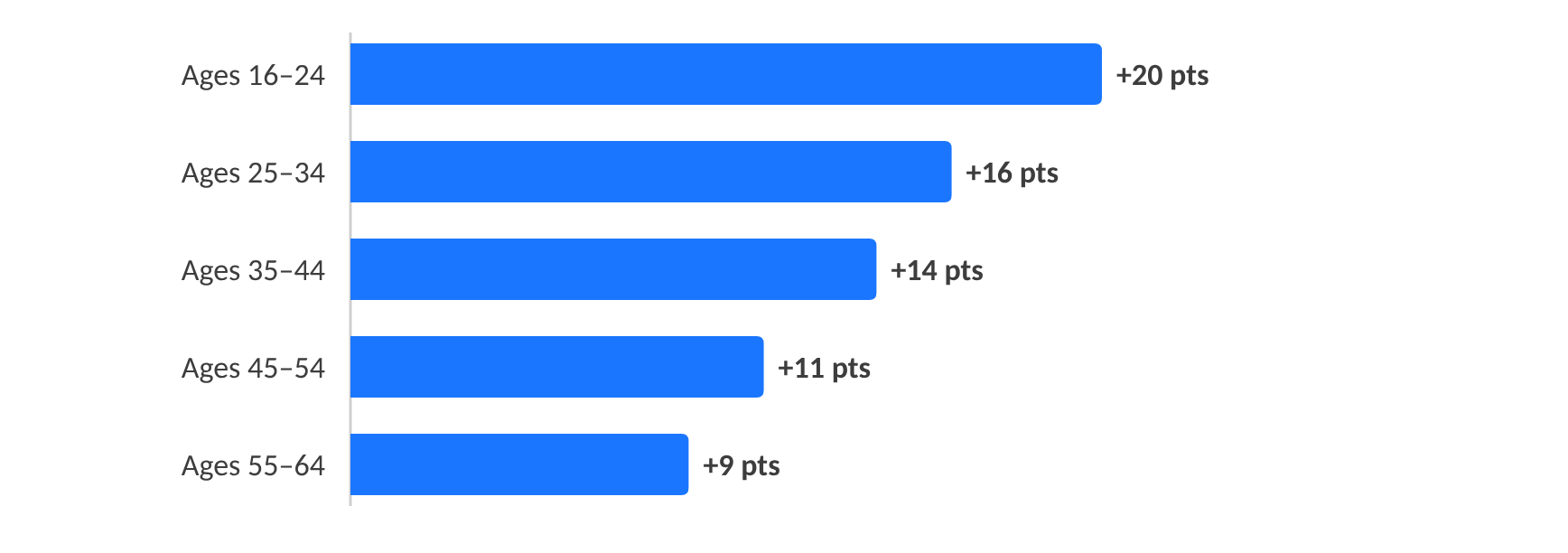
Social media’s rapid growth is what makes it such a powerful force in marketing. With big names like Facebook and Instagram reaching billions of people each day, it’s remarkable that this growth shows no signs of stopping. Instagram, for example, continues to attract a larger audience of all ages. In less than two years, the share of 16- to 24-year-olds with an Instagram account jumped 20 percentage points, from 40% to 60%.16 That isn’t the only age group that has grown, though; older generations are increasing over time as well. The share of 55- to 64-year-olds rose 9 percentage points, from about 7% to 16%.16 That growth has continued: today, about eight in ten U.S. adults ages 18 to 29 use Instagram, and half of all U.S. adults are on the platform.17 Beyond Instagram, Meta’s numbers are astonishing. As of June 2026, 3.6 billion people use at least one of Meta’s apps, including Facebook, Instagram, WhatsApp, and Messenger, every day.18 These kinds of numbers show the promising results of marketing through social media.
Chart 2
Percentage-point increase in the share of internet users with an Instagram account over two years, by age group
Source: GlobalWebIndex
Instagram isn’t the only social media platform booming, though. Almost every major platform has seen growth. Pinterest was once found to be the fastest-growing social platform in both members and active users.19 On top of this, social media’s audience keeps growing at an incredible rate. Between April 2025 and April 2026, the world added 294 million new social media user identities, a 5.4% increase.1 The combination of more people on the internet and a greater share of the internet population logging on to social media leads to a dramatically increasing number of social media users worldwide.
Driving in-store sales through social media begins with acknowledging its power. Social media is not something to be underestimated or underused. If done correctly, your brand could quickly reach the literal billions of social media users. Reaching all of these potential customers is a great start to attracting in-store sales. How you plan to use social media to reach your customers makes a big difference. As with TV commercials or billboards, you need to post content that will not only catch your followers’ attention but engage them. As social media continues to change and advance, being on the cutting edge of these technologies is necessary to stand out from your competitors. Just as Taco Bell took advantage of Snapchat’s new lens feature, your store must try something other than a simple post on Facebook or X to stay relevant. When you can get your followers to share your posts or use your content, they have effectively become your own personal advertisers.
67% of shoppers research online before buying in-store
Once you have established a loyal following, attracting more in-store sales should be more feasible. By posting about in-store-only discounts, location-specific coupons, or even free merchandise, you can attract new and returning customers alike into your stores. Finding ways to merge the online and in-store shopping experiences is also a great idea. Considering that 67% of shoppers say they research products online and then buy them in a physical store,20 finding a way to bring the online experience into the store, as Nordstrom did with Pinterest, would be incredibly beneficial to your brand. Whether it’s creating a “most shared” section or placing positive online comments about a product above it in the store, bridging the gap between online and in-store is always a good idea for your brand.
Lastly, another underrated way to get consumers involved with your brand is competition. People love competition, and giving them something to compete over is an excellent way to win both their engagement and their loyalty. A simple hashtag competition or an Instagram post challenge with rewards for participants is a great start to driving brand recognition, which leads to higher in-store sales.
Focusing on a single social media platform is no longer a viable option if you are trying to stand out among your competitors. To successfully engage consumers and drive in-store sales, it’s necessary to be both active and effective on a variety of platforms. Engaging users across multiple sites is necessary to keep them involved as loyal customers.
Collective Bias conducted a study on how U.S. consumers’ online behaviors affect in-store purchase decisions.21 With a sample of 14,000 adults surveyed, the study gathered a great deal of relevant information about these consumers’ choices. Facebook ranked as the most persuasive channel, with 19% of consumers using it to inform their purchasing decisions. Twitter, on the other hand, was found to be far less useful. A mere 2% of people surveyed went to the platform first when researching products, and even fewer said it had the most influence on their in-store purchases. While the information gathered by Collective Bias is helpful for developing good social media marketing strategies, much is still unknown about exactly what it takes to drive consumers into your store.
A group of 100 participants was surveyed to learn more about their shopping habits and their relationship to social media.22 The results provided several new angles on the power of social media and, in many ways, backed up what was already believed to be true.
Of the participants surveyed, 66% stated that Facebook was the social media platform they used most often. Following Facebook were Twitter with 8%, Instagram at 5%, Pinterest at 4%, Snapchat with 2%, and Tumblr with 1%. These results vary from previous research because they deal directly with the amount of time spent on each individual platform. While the number of active Instagram and Snapchat users had been soaring, that did not necessarily translate into more time spent on those apps, as these results show.
When viewing social media as a medium for brand awareness, it’s important to note that more than one in three users follow the accounts of their favorite stores. Of these users, 64% follow to learn about announced sales or deals, while the next-highest group, 23%, is simply interested in staying up to date with the brand. Understanding that many social media users are interested not only in following your brand but also in finding deals is important for running an effective online campaign.
With the goal of drawing customers into your physical store, it’s crucial to know whether social media is even an effective way to do so. More than half (52%) of people surveyed stated that they had visited a physical store because of a promotion, deal, or event they had seen on social media. This alone shows that social media can be, and is, effective at driving in-store sales for a large number of consumers. On top of this, nearly one in five people use social media multiple times each month to express their opinions about a brand or product. With this information, the online attention consumers give your product can be converted into positive buzz.
Chart 3
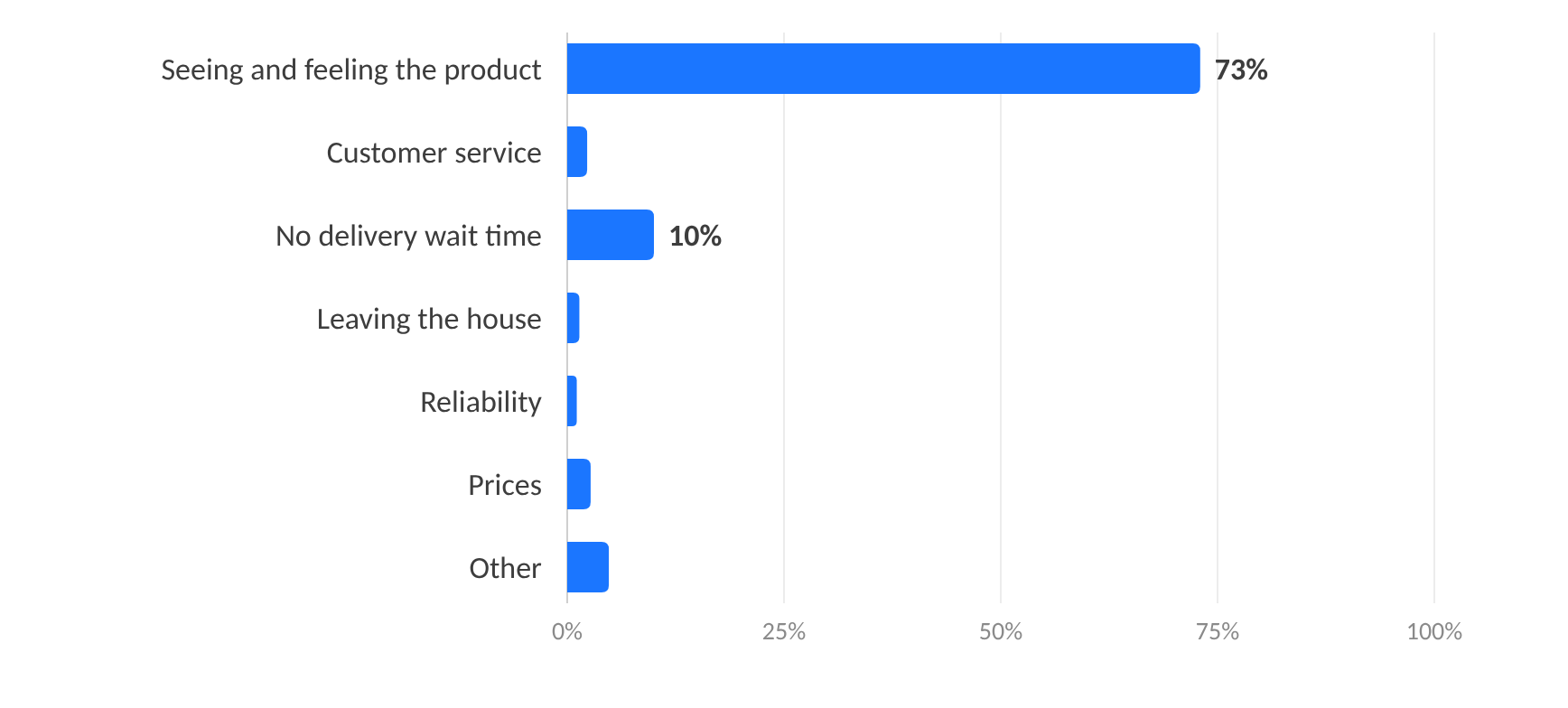
Bright Age survey of 100 people about their social media and shopping habits
When it comes to the in-store experience, businesses need to understand what is driving current customers into their physical locations. An overwhelming 73% of respondents said their favorite part of the in-store experience is being able to see and feel the product. The second-highest result, at 10%, was the desire to purchase something immediately rather than waiting for it to be delivered. Focusing your social media campaign on this highly desired ability to experience the product in person, combined with a mention of no wait time, will make it easier to drive in customers and grow sales.
Social media has proven its worth in the physical world time and time again, and this survey validates exactly that. Knowledge of what consumers enjoy about in-store shopping can be used to each brand’s advantage. With a better understanding of where online users are placing most of their attention and what it takes to get them into the store, an effective advertising campaign can be put together to draw in larger crowds.
Dog Haus, a craft-casual hot dog chain, opened its first franchised location in Canoga Park. To ensure the success of the grand opening, Dog Haus partnered with Bright Age to develop a strong social media marketing campaign. Bright Age was presented with the challenging task of creating word of mouth and buzz around the Dog Haus brand in a new geographic location. With a focus on driving in-store sales through social media, Bright Age took advantage of many of the practices discussed in this paper.
The sheer advertising power of Facebook made it the obvious choice for Bright Age’s primary focus throughout this campaign. With Facebook, Bright Age could segment the target audience into two primary groups: students and adults. Each group received its own messaging tailored to it. Segmenting the audiences lowered the cost per Page Like and increased the click-through rate. The Facebook ads placed in front of these targeted audiences resulted in both likes and engagement for the Canoga Park page.
In addition to advertising the grand opening, Bright Age engaged users by starting conversations with them online. The team made sure all customer questions and concerns were addressed promptly, professionally, and in accordance with corporate guidelines. Responding to every customer comment created a more personal, local feel for the newly franchised business.
The tactics Bright Age used proved to be quite a success when it came to driving those much-desired in-store sales for the opening. On opening day alone, Dog Haus served over 1,000 meals. The popularity of the hot dog restaurant did not end there; by the end of the first month, Dog Haus had reached an average of 350 meals sold per day. Leading up to the grand opening, Bright Age achieved 1,636% growth in Facebook Page Likes. In just the first week, the campaign achieved a click-through rate of over 7.2% and received over 38,000 impressions. In total, this astounding campaign generated 274,000 Facebook impressions, 5,515 interactions, 4,176 likes, 792 comments, and 543 post shares.
As the two-year anniversary in Canoga Park approached, Dog Haus had big plans for a special campaign. It wanted Bright Age to develop a social media marketing strategy to promote a Free Combo Upgrade. Having run similar promotions before, Bright Age tried a new tactic for drawing in customers: a campaign that allowed customers to text a phone number to receive their coupon. With this new strategy, Dog Haus saw many more participating customers, since texting is much faster and more efficient than receiving an email in an already overflowing inbox. The campaign yielded over 35,000 impressions at a cost of less than $2.90 per 1,000 impressions. It generated 471 text requests for the coupon and 203 coupon redemptions. The text messaging campaign was extremely cost-efficient and beneficial for this Dog Haus location. With a new-customer acquisition cost of only $1.94 per customer, Bright Age was able to show Dog Haus the strong return on investment of social media marketing. Thanks to its low cost and precise data, this type of campaign became a favorite of both Dog Haus and Bright Age.
Through Facebook, texting, and effective advertising tactics, Bright Age’s success in driving in-store sales for Dog Haus Canoga Park is clear. Selecting an effective target market, combined with top-of-the-line customer service, created the build-up needed for a highly successful grand opening and events. Since these campaigns, Bright Age has continued working with Dog Haus to create comparable experiences for more than 20 additional franchise locations across the United States.23
Today, deciding whether to use social media for your brand is no longer optional. Placing your brand on social media could very well be considered a necessary move for its success. The important issue now is using these platforms to their full potential. How can your business avoid the trend of waning in-store sales by using social media?
It is no secret that online shopping is extremely popular. E-commerce now accounts for 17.1% of all U.S. retail sales and grew 12.2% year over year in the second quarter of 2026, showing no signs of slowing down.4 While the research presented shows the undeniable success of online shopping, it also presents many reasons to hold on to the precious in-store shopping experience. Knowing that 85% of consumers prefer the in-store experience,24 and that they are willing to pay 50% more for items they can physically touch and see,7 should be convincing enough to stick with the brick-and-mortar experience. But with in-store traffic having fallen by as much as 15% a year in the mid-2010s,8 holding on to these locations has proven more and more difficult.
Social media is the crucial link between the online and in-store experiences and should be embraced sooner rather than later. By bridging the gap between the virtual and the real, your store can and will experience great success. From Nordstrom’s successful real-world “pin boards”15 to Taco Bell’s game-changing Snapchat campaign,12 drawing in customers through social media is becoming more competitive, but also more beneficial.
Bright Age manages and perfects businesses’ social media posts, optimizing them to drive the maximum number of customers through the door. With a focus on digital content and cost efficiency, Bright Age should be your next stop if you are trying to drive those much-desired in-store sales up.
Yes. In Bright Age’s survey, 52% of people had visited a physical store because of a promotion, deal, or event they saw on social media, and Deloitte found that digital interactions influence 56 cents of every dollar spent in brick-and-mortar stores.
Coupons and codes that can only be redeemed in store, free giveaways, in-store events, location-specific offers, and hashtag or photo contests with rewards. Responsive customer service on social media also builds the loyalty that brings customers back.
Shoppers want to see and feel the product and take it home right away. In Bright Age’s survey, 73% said seeing and feeling the product is their favorite part of shopping in store, and Caltech found consumers are willing to pay an average of 50% more for items they can touch and see.
Facebook. A Collective Bias study of 14,000 U.S. adults found Facebook was the most persuasive channel, with 19% of consumers using it to inform purchasing decisions. In Bright Age’s own survey, 66% of participants said Facebook is the platform they use most often.
Bright Age Digital Creative Agency is a boutique firm dedicated to developing innovative campaigns that clients can be proud of. Being located in Westlake Village, California, keeps the team close to the quick pace of the Los Angeles lifestyle while allowing it to focus locally and benefit the beloved small business. Bright Age has received five separate awards in a single year for its excellent work on digital marketing campaigns and web design. The agency offers a wide span of digital services, including social media advertising, market research, search engine optimization, and much more. Every team member has earned at least a four-year university degree with a concentration in business, marketing, advertising, or design. With a strong emphasis on being a partner instead of just a service provider, Bright Age is dedicated to developing long-term, successful relationships with brands.
Chart sources
Talk with our team of social media experts who understand your brand and the strategies that work in your industry.


